
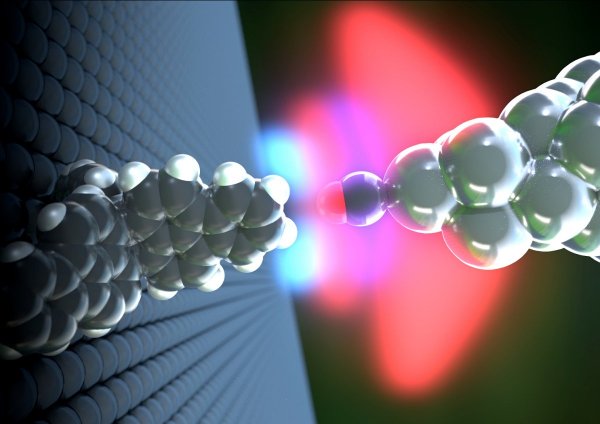
For the first time, scientists have directly imaged a hydrogen bond—the weak but vital interaction that helps give water its unique properties and holds together the double helix of DNA. The achievement, reported in the journal Science Advances, was led by researchers at the University of Basel's Swiss Nanoscience Institute, working with colleagues in Japan.
Hydrogen is the most abundant element in the universe, accounting for about 75 percent of all visible matter and over 90 percent of all atoms. Yet its bonds are among the weakest in nature, making them notoriously difficult to observe. Until now, direct visual evidence of a hydrogen bond had remained elusive.
The team used an atomic force microscope (AFM), a high-resolution scanning probe capable of detecting minuscule forces. To make the instrument sensitive enough, they added a carbon monoxide layer to the AFM tip. This layer formed a bond with the tip of a propellane molecule—a compound named for its propeller-like shape. By measuring the force and distance between an oxygen atom and two hydrogen atoms, the researchers obtained a clear signature of the hydrogen bond.
“The hydrogen atom—the smallest and most abundant atom—is of utmost importance in physics and chemistry,” the researchers wrote in their paper. “Although many analysis methods have been applied to its study, direct observation of hydrogen atoms in a single molecule remains largely unexplored.”
The challenge has been twofold: hydrogen bonds are fragile and easily broken, and hydrogen atoms are the smallest of all atoms, making them extremely hard to detect. But the new technique overcomes these obstacles, providing a way to visualize the very forces that underpin much of chemistry and biology.
Why Hydrogen Bonds Matter
Hydrogen bonds are fundamental to life as we know it. They give water its unusual properties—its high boiling point, surface tension, and solvent abilities—and they are the glue that holds the two strands of DNA together. Understanding these bonds at a fundamental level could shed new light on genetic structure and the behavior of complex molecules.
The researchers’ calculations confirmed the signature of directional bonding, a hallmark of weak hydrogen bonds. They suggest that the ability to directly measure interactions with hydrogen atoms could pave the way for identifying three-dimensional structures of molecules such as DNA and polymers.
“Hydrocarbons are one of the most varied and functionalized products at the heart of engineering, chemistry, and life, and hydrogen is often critical in their function,” the Swiss team noted. This research, they add, could be the first step toward a deeper exploration of the material world.
The findings open up new possibilities for studying molecular interactions at an unprecedented level of detail, offering a clearer window into the forces that shape our physical and biological world.










Comments
Sign in to leave a comment
No account? Create one
No comments yet.