
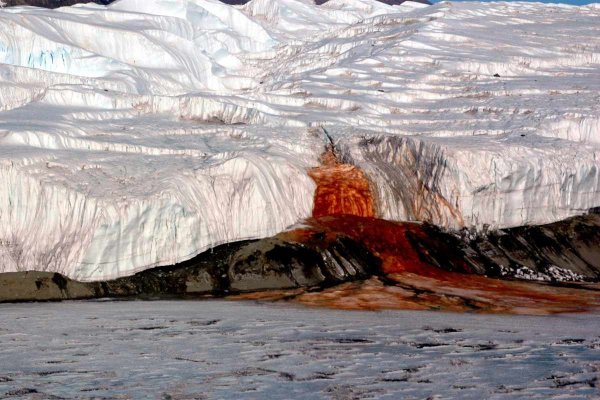
For over a century, a crimson torrent spilling from the edge of Taylor Glacier in eastern Antarctica has fueled speculation ranging from alien activity to a macabre sign of climate distress. Now, a team of geoscientists says the so-called Blood Falls is the product of a purely mechanical process: the immense weight of the glacier itself, shifting and pressing on a buried, briny reservoir, forces the rust-colored water upward through cracks in the ice.
The explanation, published in the journal Antarctic Science, closes a scientific puzzle that began in 1911, when geologist Thomas Griffith Taylor first documented the striking feature that now bears his name. Taylor, part of Robert Falcon Scott's ill-fated Terra Nova expedition, observed the red stain on the glacier's snout but had no way to determine its origin.
Early theories attributed the color to microscopic algae, a notion that held sway for decades. But by the late 20th century, researchers had shifted focus to iron—specifically, iron in the water that oxidizes on contact with air, much like rust forming on metal. That hypothesis gained traction, yet it left a nagging inconsistency: the iron did not appear in the expected mineral form.
A Century-Old Puzzle, Refined
More recent analysis, using advanced imaging and chemical techniques, revealed that the iron is packaged within tiny spheres, each only nanometers across. These nanospheres, scientists believe, were formed by ancient bacteria that thrived in a lake buried deep beneath the glacier. The microbes metabolized metals from the lake bed, concentrating iron into these minuscule structures. The water itself, researchers found, is extremely salty—so briny that it remains liquid at temperatures far below freezing, which explains why the outflow never solidifies.
But the question of what actually drives the water to the surface remained open. The new study, led by Peter Doran, a geoscientist at Louisiana State University, offers an answer grounded in direct observation.
Glacier's Weight Triggers Eruptions
Doran and his colleagues combined GPS data, time-lapse photography, and real-time temperature sensors to monitor the Blood Falls over several years. Their instruments captured a significant eruption in 2018, and the data revealed a telling sequence: as the glacier's surface dropped by less than an inch, temperatures deep beneath the ice plunged, indicating a sudden release of pressure.
That pressure drop, the team concluded, is the trigger. The glacier, constantly moving and adjusting, occasionally shifts its weight, compressing the buried lake and forcing the briny water through fissures in the ice. The result is a dramatic, crimson burst that can flow for hundreds of meters across the glacier's surface.
The findings do not address broader questions about Antarctic ice dynamics or climate change, but they do resolve a long-standing curiosity about one of the continent's most photographed natural phenomena. For scientists, the study underscores how even the most bizarre-looking features can arise from familiar physical processes, given enough time and the right conditions.











Comments
Sign in to leave a comment
No account? Create one
No comments yet.