
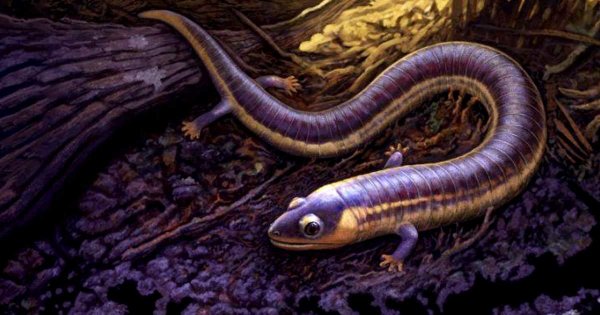
Paleontologists at Virginia Tech have identified a newly discovered amphibian fossil that dates back roughly 230 million years, and they’ve given it a name inspired by a 1972 funk track. The species, Funcusvermis gilmorei, is a primitive caecilian—a limbless, burrowing amphibian with a distinct double row of teeth—and its discovery helps bridge a significant gap in the evolutionary history of these secretive creatures.
The fossil was unearthed during a 2019 dig at Arizona’s Petrified Forest National Park, a site known for its rich Triassic-era deposits. Ben Kligman, a doctoral student in geosciences at Virginia Tech and co-discoverer of the fossil, described the moment of recognition in a university statement: “Seeing the first jaw under the microscope, with its distinctive double row of teeth, sent chills down my back. We immediately knew it was a caecilian, the oldest caecilian fossil ever found, and a once-in-a-lifetime discovery.”
Before this find, researchers had struggled to trace caecilians’ origins because of a roughly 87-million-year gap in the fossil record. The new specimen, described in a recent issue of the journal Nature, provides a crucial link, showing skeletal features that align more closely with early frog and salamander fossils than with later caecilians. This suggests that caecilians share a deeper common ancestry with other amphibian groups than previously thought.
The species name gilmorei honors Ned Gilmore, a collections curator at Drexel University’s Academy of Natural Sciences, with whom Kligman volunteered as an undergraduate. The genus name, Funcusvermis, is a playful nod to the Ohio Players’ 1972 song “Funky Worm,” which was a favorite among the research team during their field work in Arizona.
Lead paleontologist Adam Marsh, also from Virginia Tech, explained the naming choice in the university’s announcement: “As the eponymous song says, it’s the funkiest worm in the world.” The lighthearted name reflects the team’s appreciation for the fossil’s odd appearance and its place in amphibian evolution.
Filling a Critical Gap in Amphibian Evolution
Caecilians are a group of amphibians that today are found in tropical regions, living underground and feeding on small invertebrates. Their fossil record has been sparse, making it difficult for scientists to determine when and how they diverged from other amphibians. The Petrified Forest specimen, which consists of jaw fragments and other skeletal elements, is now the oldest caecilian fossil known, offering a rare glimpse into the early evolution of this lineage.
The discovery also underscores the importance of continued exploration in the Petrified Forest National Park, which has yielded numerous Triassic fossils. The site’s geological formations have proven to be a rich source of information about life more than 200 million years ago, and this find adds to that growing body of knowledge.
While the name may be whimsical, the scientific implications are substantial. By placing Funcusvermis gilmorei in the amphibian family tree, researchers can better understand how caecilians developed their unique adaptations, such as limblessness and a specialized skull. The study also highlights the value of revisiting museum collections and field sites with fresh eyes, as new discoveries often come from unexpected places.
For now, the fossil is housed at the Petrified Forest National Park, where it will remain available for further study. The team’s findings have been published in Nature, and the research was supported by the National Science Foundation and the park’s paleontological resources program.











Comments
Sign in to leave a comment
No account? Create one
No comments yet.