
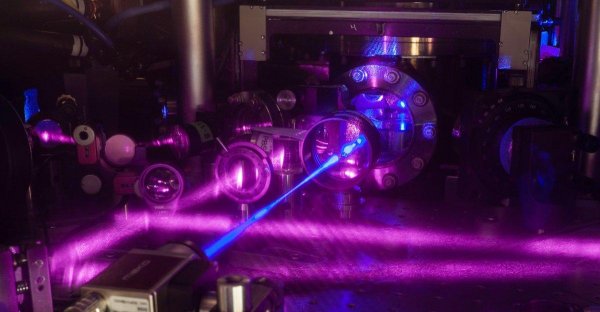
BOULDER, Colo. — A novel atomic clock that harnesses a quantum gas has achieved a record level of precision, a development that could sharpen the search for dark matter and push the boundaries of measurement science. The instrument, built at JILA, a joint institute of the University of Colorado Boulder and the National Institute of Standards and Technology (NIST), marks the first successful use of a quantum gas in such a device.
The clock confines strontium atoms in a three-dimensional lattice, achieving a density roughly a thousand times greater than that of earlier one-dimensional designs. This architecture allows the atoms to behave as a single quantum system, a so-called quantum many-body state, rather than as independent particles. In previous clocks, interactions between atoms introduced errors; here, the atoms are organized in a pattern that prevents collisions, regardless of how many are added.
During tests, the clock recorded an error rate of just 3.5 parts in 10 quintillion — the first atomic clock to reach that level of accuracy. The improvement stems from the use of a degenerate Fermi gas, a state of matter in which all atoms share the same quantum properties, effectively forcing them to avoid one another.
Why This Matters for Dark Matter
The enhanced stability of the clock could be pivotal for detecting dark matter, which remains one of physics' most elusive mysteries. Scientists have proposed that pockets of dark matter might subtly alter the frequency of vibrating atoms or laser light in a clock. A network of highly sensitive clocks, or even a single one, could register such a change as it passes through a dark matter field. The new clock's stability makes it a promising tool for this kind of search.
Physicist Jun Ye, who led the project, emphasized the potential for scaling up the number of atoms, which would yield significant gains in stability. "We are entering a really exciting time when we can quantum engineer a state of matter for a particular measurement purpose," he said.
Thomas O'Brian, chief of NIST's quantum physics division and Ye's supervisor, called the clock "an early and astounding success in the practical application of the 'new quantum revolution.'" He added that the approach holds promise for a broad range of measurements and technologies beyond timing.
Atomic clocks are already critical for timekeeping and navigation, but this breakthrough could extend their utility to fundamental physics. The ability to harness quantum correlations in a practical device opens the door to new types of sensors and experiments, potentially reshaping our understanding of the universe.











Comments
Sign in to leave a comment
No account? Create one
No comments yet.