
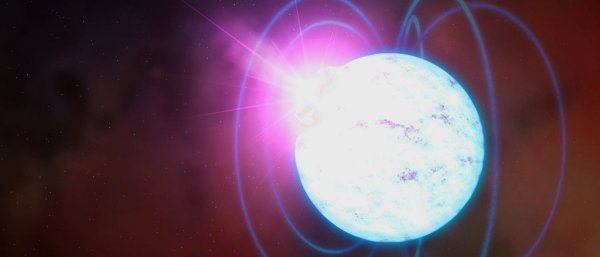
Astronomers using NASA's Swift satellite have detected a wind nebula—a vast cloud of high-energy particles—surrounding a magnetar for the first time, a finding that upends long-held assumptions about these extreme objects and their environments.
The discovery centers on Swift J1834.9-0846, a magnetar first identified in 2011. Magnetars are a rare type of neutron star, the collapsed cores of massive stars that exploded as supernovae. Their defining trait is an extraordinarily powerful magnetic field, reaching up to 1 quadrillion gauss—about 1,000 trillion times stronger than the magnetic field typically experienced on Earth.
That intensity has stark implications for anything that ventures too close. Astrophysicist Paul Sutter, writing about magnetars, noted that within roughly 1,000 kilometers (600 miles), the magnetic field would disrupt not only nerve impulses but also molecular structures, effectively causing a person to dissolve.
Of the approximately 2,600 neutron stars cataloged to date, only 29 have been classified as magnetars. The new observation marks the first time one has been found wrapped in a wind nebula, a structure previously thought to exist only around young pulsars—rapidly spinning neutron stars that emit beams of radiation.
Pulsars generate wind nebulae when their fast rotation drives a flow of charged particles into the surrounding space, creating a glowing shell of energized gas. As pulsars age and their spin slows, these nebulae typically dissipate. Magnetars, however, spin more slowly than even older pulsars, which makes the presence of a persistent wind nebula around J1834.9 particularly puzzling.
“Right now, we don’t know how J1834.9 developed and continues to maintain a wind nebula, which until now was a structure only seen around young pulsars,” said George Younes, the lead researcher from George Washington University.
Why This Magnetar Defies Expectations
The team’s analysis, based on data from the Swift satellite, indicates that the nebula’s glow may be powered by the magnetar’s rotational energy. Younes noted that if the process is similar to that seen in pulsars, about 10 percent of the magnetar’s rotational energy loss could be fueling the nebula’s luminosity—the highest efficiency ever recorded for such a system.
That estimate, if confirmed, would make J1834.9 an outlier not only in its nebula but also in how efficiently it converts spin into radiation. The finding also hints that magnetars, despite their chaotic and poorly understood behavior, may share more in common with pulsars than previously recognized.
Jonathan Granot, an astrophysicist at Israel’s Open University, called the discovery “a unique opportunity to study the magnetar’s historical activity, opening a whole new playground for theorists like me.” The nebula acts as a fossil record of the magnetar’s past output, allowing researchers to trace its evolution over time.
The research team plans to continue monitoring J1834.9 with Swift and other observatories to gather more data on how the nebula changes and to test their models of magnetar wind interactions. The findings could reshape theories of neutron star evolution and the role of magnetic fields in shaping their surroundings.











Comments
Sign in to leave a comment
No account? Create one
No comments yet.