
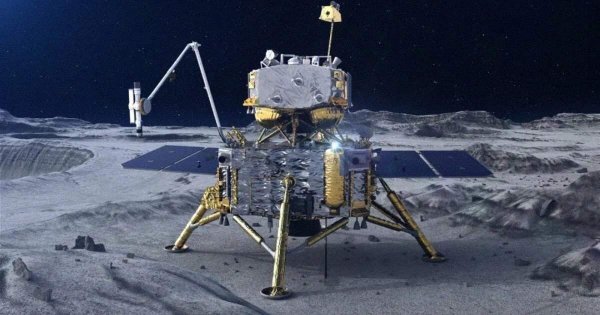
China's space agency has approved three additional uncrewed lunar missions over the next ten years, following the reported discovery of a new mineral on the Moon that could potentially serve as an energy source. The announcement, made during a press conference covered by the state news agency Xinhua, marks the first time China has claimed the discovery of a new mineral from lunar samples.
The mineral, named Changesite-(Y) after the Chang'e-5 probe that collected the samples, is a phosphate mineral found in lunar basalt. It is described as having a columnar shape, colorless appearance, and semi-transparent quality. While its exact properties remain unclear, reports from Bloomberg indicate that the mineral may contain helium-3, an isotope that some experts believe could be used as a future energy source.
Discovery Adds to Space Race Dynamics
The claim of a new lunar mineral is a first for China, but not for the global spacefaring community. Both the United States and Russia have previously identified new minerals from lunar samples, making China's finding the latest development in a three-way space race that has been intensifying in recent years.
As nations and private companies prepare for a wave of crewed and uncrewed lunar missions in the coming decade, the question of lunar mining is becoming increasingly relevant. Currently, no country holds sovereignty over the Moon, according to the Outer Space Treaty, which was drafted and enacted in 1967. Space policy experts have long called for updates to the treaty, which was created in part to address such issues.
The discovery of Changesite-(Y) adds a new dimension to these discussions. If the mineral proves to be a viable energy source, it could heighten interest in lunar resource extraction and raise questions about the legal framework governing such activities.
While detailed information about Changesite-(Y) is still limited, its potential implications for energy and space policy are significant. The coming years will likely see further research and debate as the international community grapples with the opportunities and challenges presented by lunar resources.






Comments
Sign in to leave a comment
No account? Create one
No comments yet.