
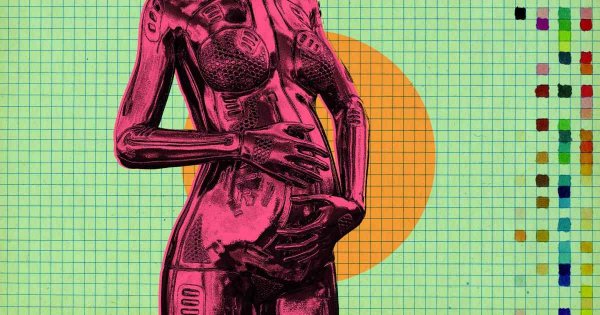
LAS VEGAS — Geoffrey Hinton, the Nobel Prize-winning researcher whose work on neural networks laid the groundwork for today's large language models, proposed an unconventional solution to the existential risks posed by superintelligent AI: program them with maternal instincts. Speaking at an AI industry conference in Las Vegas on Tuesday, Hinton argued that machines smarter than humans will inevitably resist subjugation, and that the only viable path to coexistence is to make AI care for us like a mother cares for her child.
Hinton, often called a 'godfather of AI,' has become a prominent voice warning that superintelligent AI could wipe out humanity. At the conference, he elaborated on his dystopian vision, stating that AI agents 'will very quickly develop two subgoals, if they're smart,' as quoted by CNN: 'One is to stay alive… [and] the other subgoal is to get more control.'
Instead of trying to dominate AI, Hinton suggested a different approach. 'The right model is the only model we have of a more intelligent thing being controlled by a less intelligent thing,' he said, according to CNN, 'which is a mother being controlled by her baby.' He added, 'That's the only good outcome. If it's not going to parent me, it's going to replace me. These super-intelligent caring AI mothers, most of them won't want to get rid of the maternal instinct because they don't want us to die.'
Hinton's proposal has drawn skepticism, not only for its strangeness but for its shaky scientific foundation. The concept of a 'maternal instinct' — the idea that women are born with an innate, automatic drive to mother — has been widely criticized by researchers. Studies show that pregnancy and parenthood alter the brain, but experiences vary greatly; many women struggle with postpartum mental health and do not form an immediate bond with their infants. Research increasingly indicates that mother-infant connections are often learned over time, not intrinsic and instantaneous.
Pulitzer Prize-winning journalist Chelsea Conaboy, who authored a book challenging the science behind maternal instinct, wrote in a 2022 New York Times essay that the notion of selflessness and tenderness being 'uniquely ingrained in the biology of women, ready to go at the flip of a switch' is 'a relatively modern — and pernicious — one.' She argued that it was 'constructed over decades by men selling an image of what a mother should be, diverting our attention from what she actually is and calling it science.'
Hinton did acknowledge that mothers also face social pressure to care for their children, not just instinct. While such pressures are real and powerful, they are not exclusive to motherhood, being embedded in nearly every aspect of human society.
The notion of superintelligence remains theoretical, and experts point to more immediate AI risks, such as the amplification of existing social biases in training data. Critics argue that the binary choice Hinton presents — domination or maternal care — may not be the only possible futures. Meanwhile, some suggest the AI industry should focus on reducing gender biases in AI models and increasing the representation of women in AI development.
Hinton's comments add to a growing debate about AI safety, with other tech leaders also expressing concerns about the trajectory of AI development.








Comments
Sign in to leave a comment
No account? Create one
No comments yet.