
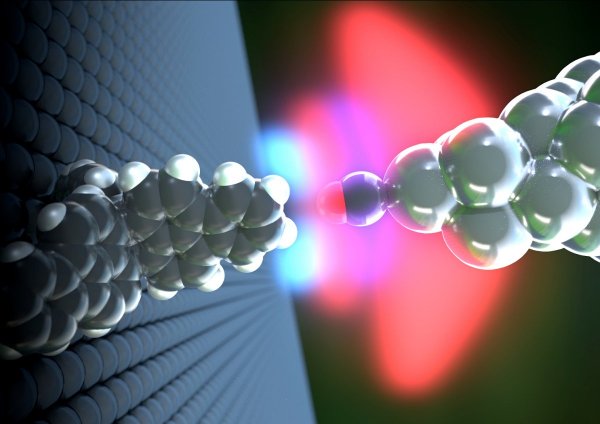
Researchers from the University of Basel's Swiss Nanoscience Institute, working with colleagues from Japan, have directly imaged hydrogen bonds for the first time, according to a paper published in the journal Science Advances. The team used an atomic force microscope (AFM) — a high-resolution scanning probe instrument capable of measuring minuscule forces — to observe the bonds, which are among the weakest molecular bonds known and had previously eluded direct study.
Hydrogen is the most abundant element in the universe, making up roughly 75 percent of all visible matter and more than 90 percent of all atoms, according to the source material. Yet hydrogen atoms are the smallest possible, and their bonds are easily broken, which has made them difficult to observe. The researchers wrote in their abstract that while many analysis methods have been applied to hydrogen, "direct observation of hydrogen atoms in a single molecule remains largely unexplored."
To achieve the measurement, the team used compounds called propellanes, named for their propeller-like shape. They measured the force and distance between an oxygen atom and two hydrogen atoms — the components of water — using an AFM made sensitive to hydrogen by adding a carbon monoxide layer at its tip. The carbon monoxide formed a bond with the tip of the propellane compounds, and that bond was studied and found to match established hydrogen bond calculations.
The researchers wrote that their calculations "confirm the signature of directional bonding, characteristic of very weak hydrogen bonding," and that the direct measurement "paves the way for the identification of three-dimensional molecules such as DNAs and polymers." Hydrogen bonds help give water its properties and hold DNA's double-helix structure together, so the technique could offer new insight into genetic structure.
The Swiss team added that hydrocarbons are among the most varied and functionalized products in engineering, chemistry, and life, with hydrogen often critical to their function. The study represents an initial step toward deeper exploration of the material world at the atomic level, though the source does not specify immediate practical applications or a timeline for further research.












Editorial Notes