
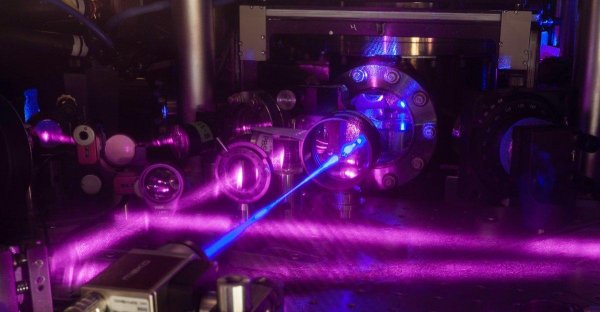
Scientists at the University of Colorado Boulder's JILA, formerly the Joint Institute for Laboratory Astrophysics, have developed a three-dimensional quantum gas clock that sets a new record for quality factor, a metric of measurement precision. The clock, which uses strontium atoms packed into a cube at 1,000 times the density of prior one-dimensional clocks, is the first to successfully use a quantum gas for timekeeping.
Unlike previous atomic clocks that treated each atom as a separate particle—allowing interactions to cause inaccuracies—the new design employs a "quantum many-body system" that organizes atoms in a pattern, forcing them to avoid one another regardless of how many are introduced. This is made possible by a state of matter known as a degenerate Fermi gas, which allows all atoms to be quantized.
In laboratory tests, the clock recorded errors of just 3.5 parts in 10 quintillion, making it the first atomic clock to achieve such accuracy. "The most important potential of the 3-D quantum gas clock is the ability to scale up the atom numbers, which will lead to a huge gain in stability," said physicist Jun Ye of the National Institute of Standards and Technology (NIST), who worked on the project. "We are entering a really exciting time when we can quantum engineer a state of matter for a particular measurement purpose."
Thomas O'Brian, chief of NIST's quantum physics division and Ye's supervisor, called the clock "an early and astounding success in the practical application of the 'new quantum revolution,' sometimes called 'quantum 2.0.'" He added that the approach "holds enormous promise for NIST and JILA to harness quantum correlations for a broad range of measurements and new technologies, far beyond timing."
Beyond timekeeping and navigation, the technology could aid the ongoing effort to understand dark matter. It has been suggested that monitoring minor inconsistencies in atomic clock ticking might reveal the presence of dark matter pockets. Previous research indicates that a network of atomic clocks, or even a single highly sensitive system, might register a change in the frequency of vibrating atoms or laser light if it passed through a dark matter field. Given its greater stability, the new clock could contribute to breakthroughs in this cosmic mystery.











Editorial Notes