
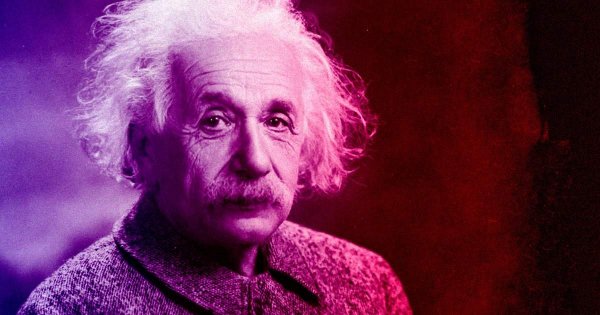
Li Zifeng, a professor at China's Yanshan University who specializes in oil drilling and engineering, says he has accomplished what most physicists would consider impossible: disproving Albert Einstein's theory of relativity. Li says he has worked on his theorem for two decades, according to the Global Times, a news outlet owned and operated by the Chinese government.
Li claims he uncovered fatal flaws in Einstein's theory while teaching a university lecture, the Global Times reported. He argues that the theory of relativity has never been tested or proven in a practical way, and that theory alone should not be considered sufficient evidence. His research claims Einstein's work "misled physicists' and basic human understanding of the world," according to the Global Times, and that by disproving Einstein, he has "removed a huge obstacle to the healthy development of science."
Despite his claims, Li says he has faced institutional obstacles. According to the Global Times, Yanshan University has not approved or recognized his research. He also appears to have submitted himself for academic awards for his work.
But his most visible obstacle has been online ridicule. Critics have compared Li's challenge to Einstein to a gym teacher attempting to solve complex math problems. The skepticism reflects the broader scientific consensus: Einstein's theory of relativity has been repeatedly validated through observation and experiment since it was published in the early 20th century.
Li's background in oil drilling and engineering, rather than theoretical physics, has fueled much of the derision. The Global Times report did not provide details on the specific flaws Li claims to have found, nor did it indicate whether his work has undergone peer review or been published in a scientific journal.
Einstein's theory of relativity remains foundational to modern physics, underpinning everything from GPS technology to particle physics. The scientific community has not recognized any credible challenge to it, and Li's claims appear unlikely to change that.











Editorial Notes