
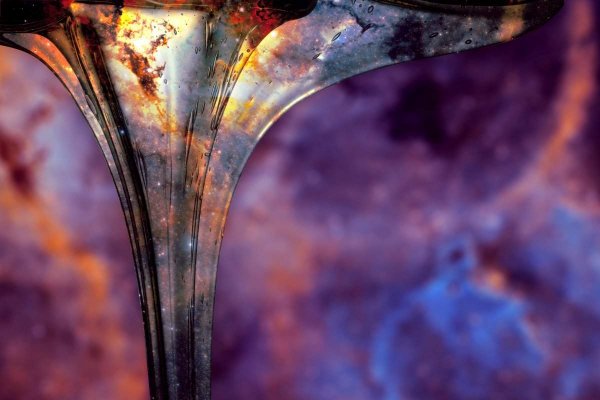
Cosmologists may need to rethink the nature of empty space. A new, yet-to-be-peer-reviewed paper flagged by Live Science proposes that space behaves like a viscous, stretchy fluid—similar to slow-moving honey—rather than a true void. The theory, put forward by Muhammad Ghulam Khuwajah Khan at the Indian Institute of Technology in Jodhpur, attempts to resolve discrepancies between recent telescopic observations and the prevailing Lambda Cold Dark Matter (ΛCDM) model.
For years, astronomers have relied on ΛCDM to explain the Big Bang, how dark matter holds galaxies together, and how dark energy drives cosmic expansion. In this framework, the energy density of space—the cosmological constant, denoted by the Greek letter Lambda (Λ)—is considered unchanging. But data from the Dark Energy Spectroscopic Instrument (DESI) survey in Arizona and the Dark Energy Survey in Chile suggest that dark energy may have weakened as the universe has accelerated and grown older, contradicting the model's assumption of constancy.
How Spatial Phonons Could Bridge the Gap
Khan's theory introduces 'spatial phonons'—vibrations emitted by atoms that create waves of tension in space. In this model, dark energy still pushes space to expand, but these phonons subtly push back. The result is a non-uniform expansion that, when layered over the DESI observations, resolves the discrepancy with ΛCDM. The idea preserves dark energy as a cosmological constant while adding a theoretical wrinkle to explain observations that seem to violate it.
However, the proposal remains speculative. More data from dark energy surveys will be needed to determine whether the theory holds up or is relegated to the dustbins of history. For now, it offers a testable hypothesis in the ongoing effort to understand the universe's accelerating expansion.











Editorial Notes