
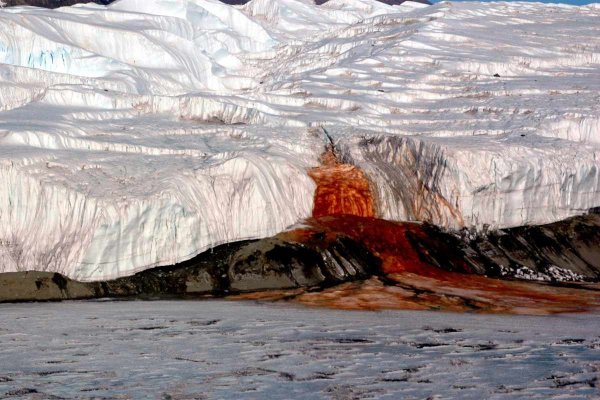
The crimson plume known as Blood Falls on the snout of Taylor Glacier in eastern Antarctica is driven by the weight and movement of the overlying glacier, according to a new study published in the journal Antarctic Science. Lead author Peter Doran, a geoscientist at Louisiana State University, and colleagues combined GPS data, a visual time-lapse of the falls, and real-time temperature readings to trace the mechanism.
When the falls erupted in 2018, instruments recorded temperatures plunging deep beneath the glacier and a drop of less than an inch in the glacier's surface. That small displacement corresponded to changes in pressure, the study says, pushing briny water from a buried subglacial lake toward cracks where it suddenly erupts.
Discovered in 1911 by geologist Thomas Griffith Taylor, Blood Falls has puzzled scientists for more than a century. Early explanations pointed to microalgae, but researchers later suspected iron in the water that oxidized on contact with air. More recent work found the iron was not in mineral form but trapped in tiny structures called nanospheres, likely packaged by ancient, metal-metabolizing bacteria in the subglacial lake, with the iron originating from the lake bed. The water's extreme salinity prevents it from freezing.
The new study addresses what had remained unresolved: what forces the water out. The answer, the researchers suggest, lies in the glacier itself. As the glacier shifts and its surface drops slightly, pressure on the hidden briny water increases, driving it toward fractures and triggering eruptions like the one observed in 2018.
The findings rely on instruments deployed at the site and do not forecast future eruption timing or intensity. The study appears in Antarctic Science.








Editorial Notes