
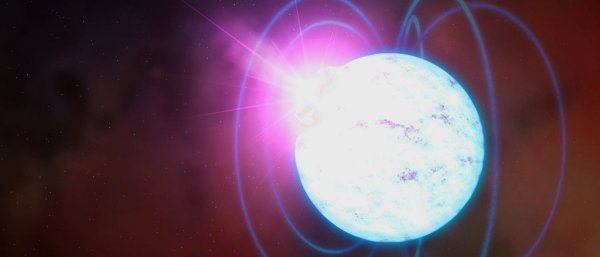
Astronomers using NASA's Swift satellite have found a wind nebula surrounding a magnetar for the first time, according to the source material. The magnetar, discovered in 2011 and named Swift J1834.9-0846, or J1834.9 for short, is enveloped in a massive cloud of high-energy particles. Only 29 of the 2,600 neutron stars ever found have been classified as magnetars, making both the object and the detection rare.
Magnetars are highly magnetic neutron stars. The source describes their fields as 1,000 trillion times more magnetic than our common environment, or up to 1 quadrillion gauss. Astrophysicist Paul Sutter, quoted in the source, said getting within about 1,000 kilometers, or 600 miles, would be strong enough to upset not just bioelectricity but molecular structure.
Why the Wind Nebula Is Unexpected
Until now, wind nebulae had been seen only around young pulsars, which spin fast enough to keep the particle cloud from escaping into space. Even those pulsars can lose their nebulae as they age and slow down. Magnetars are known to spin slower than regular pulsars, making it baffling how J1834.9 maintains its wind nebula.
"Right now, we don't know how J1834.9 developed and continues to maintain a wind nebula, which until now was a structure only seen around young pulsars," said lead researcher George Younes from George Washington University.
Researchers plan to investigate further. Jonathan Granot from Israel's Open University said the magnetar "represents a unique opportunity to study the magnetar's historical activity, opening a whole new playground for theorists like me." Younes added that if the process is similar to that in pulsars, about 10 percent of the magnetar's rotational energy loss powers the nebula's glow, which would be the highest efficiency ever measured in such a system.
Magnetar behavior remains chaotic and poorly understood. The source does not specify a timeline for follow-up observations or what instruments might be used.












Editorial Notes