
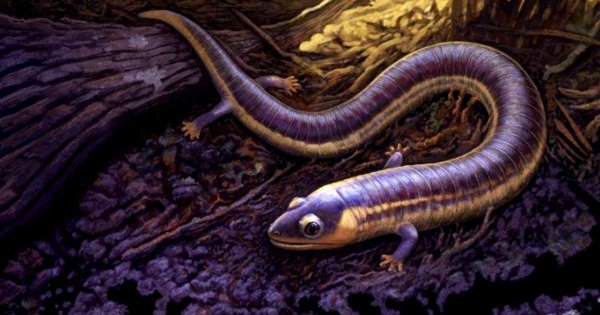
Virginia Tech paleontologists have named a newly discovered ancient amphibian after a 1972 funk song, and the fossil itself is filling a major gap in the evolutionary history of one of the world's strangest amphibians.
The species, Funcusvermis gilmorei — or "funky worm" — was described in a recent issue of the Nature journal. It belongs to the caecilian lineage, a group of toothy, limbless, subterranean amphibians whose origins had long puzzled researchers. According to a Virginia Tech press release, the fossil is the oldest caecilian ever found, bridging an 87-million-year gap between known ancestors.
Ben Kligman, a geoscience doctoral student at Virginia Tech and co-discoverer of F. gilmorei, described the moment he first examined the specimen. "Seeing the first jaw under the microscope, with its distinctive double row of teeth, sent chills down my back," Kligman said in the release. "We immediately knew it was a caecilian, the oldest caecilian fossil ever found, and a once-in-a-lifetime discovery."
The fossil was discovered during a 2019 dig at Arizona's Petrified Forest National Park. According to the university's statement, the species was named after the Ohio Players' 1972 song "Funky Worm," which was a favorite of one of the study authors during the excavation. The second part of the name honors Ned Gilmore, a collections curator at Drexel University's Academy of Natural Sciences, where Kligman volunteered as an undergraduate.
The press release notes that F. gilmorei shares skeletal features more closely with early frog and salamander fossils, suggesting caecilians may share origins with other amphibians. Lead paleontologist Adam Marsh embraced the unconventional naming in the release. "As the eponymous song says," Marsh said, "it's the funkiest worm in the world."












Editorial Notes